Disability-Specific
Disability-Specific
Disability-Specific Resources
Explore disability-specific information, tools, and strategies to support the needs of diverse learners. This page features free resources to equip parents and teachers with tools to help ALL students reach their potential.
Resources
Resources for Students with Disabilities in New Jersey
NJDOE - The Office of Special Education
NJDOE Approved Clinics and Agencies
Children with Disabilities | NJ Disability Information Hub
Developmental Disabilities Family Support Services | NJ DCF
Family Support Organization | Cumberland, Gloucester, Salem
Intellectual and Developmental Disability Resources for Families
NJ Family and Community Resources | NJ PBSIS
NJ Statewide Parent to Parent (P2P NJ)
NJ Council on Developmental Disabilities | Resource by Subject
Parents with Disabilities & Chronic Health Challenges | NJ Parent Link
Auditory Impairment (Deaf and Hard of Hearing)
ASL Nook - Featuring a family of native ASL users, each short ASL Nook video centers on a theme, from school signs to patriotic signs to animal signs, presenting language in context, showing the adults and children interacting.
Central Institute for the Deaf (CID) Professional Resources | Free Downloads - As part of CID’s commitment to serve professionals who support children who are deaf or hard of hearing, they provide helpful, relevant downloads for free. The handouts listed on this page can be used as a reference in your office, classroom, or home.
Educational Program Planning Guide for Students who are Deaf/Hard of Hearing | NJDOE - Presently in New Jersey, the methods for determining the levels and types of services needed vary among school districts. It was decided that a rubric would be most effective for providing uniform guidance to Local Education Agencies (LEAs) for determining the types of instructional support and/or related services, and the frequency and appropriate personnel to deliver these services.
NAD - American Sign Language - Recommendations from the National Association of the Deaf, including What is ASL?; Community and Culture – FAQ; Learning ASL; Teaching ASL and more.
NJ Division of the Deaf and Hard of Hearing - Find information regarding support, training, ALS, and the NJ Hearing Aid Project.
NJ Deaf Student's Bill of Rights - The Deaf Student’s Bill of Rights is a statement of responsibility to ensure that school districts meet the unique needs of students who are deaf, hard of hearing, or deaf-blind and use varied communication modalities.
The Scope of Service of Professionals in Deaf Education | NJDOE - The education and support of students who are Deaf or hard of hearing (DHH) involves a team of specialized professionals, each contributing unique expertise to ensure these students thrive academically and socially. These professionals play distinct yet complementary roles, from providing tailored instruction to facilitating communication and managing auditory technology. Understanding the specific responsibilities of teachers of the Deaf/hard of hearing (TOD), educational interpreters, audiologists who consult in education, and speech-language specialists is crucial for creating a cohesive and effective educational environment for these students.
Students who are Deaf or Hard of Hearing | NJDOE - In August 2019, two pieces of New Jersey legislation were signed for the purpose of supporting children who are Deaf or Hard of Hearing. Resources include a downloadable Educational Planning Guide.Augmentative and Alternative Communication (AAC)
ABA Free Resources - Free ABA samples, picture communication, social stories and more.
ADSA: Low Tech Communication Board Library - The Low Tech Communication Board Library is a collection of downloadable communication boards (PDF files) as well as helpful links you can click on (-video; -website; -song) to use with individuals with communication needs.
Augmentative and Alternative Communication (AAC) - Speech | ASHA.org - Children and adults with severe speech or language problems may need to find other ways to communicate besides talking. There are many types of Augmentative and Alternative Communication (AAC) they can use.
Braille Resources - Braille Bug - Braille based resources for the home and classroom.
DDFSS | Assistive Technology Links - Tips, strategies and resources for using Augmentative Communication with children.
Free communication cards for augmentative and alternative communication (AAC) - These cards are easily downloadable in a PDF format with working buttons, ensuring easy access without the hassle of downloading additional apps on devices. They are designed to be easily understood and can be used by adults and children alike, including those with neurodevelopmental disorders. The cards cover a range of everyday topics and situations, in 5 languages, providing a simple yet effective tool for enhancing communication.
National Braille Press | Education - National Braille Press is anchored in education. Our approach offers the opportunity for blind and visually impaired students to learn in a world where access is universal, and high-quality braille and tactile graphics are not only necessary, but required.
NJ Division of the Deaf and Hard of Hearing - Find information regarding support, training, ALS, and the NJ Hearing Aid Project
Pyramid Education Consultants | Free Materials - Free materials for professionals and caregivers to support your efforts with your learners.
SET-BC | Search for Classroom & Training Resources - Helping to provide the support needed to better educate students with complex needs.
Special Education and Inclusive Learning: Encouraging the Use of AAC Devices in Every Lesson - Augmentative and alternative communication (AAC) devices are becoming increasingly common in classrooms as technology advances. Tips for incorporating AAC devices into classroom routines and free educational games for AAC users
Students with Limited Verbal Capabilities Can Thrive in Inclusive Classrooms - With the right support, students who cannot rely on natural speech to communicate can do well in integrated classrooms.
Universal Core Communication Systems - The Universal Core vocabulary is a set of 36 highly useful single words that can be used alone or in combination to communicate on a range of purposes across numerous topics with a diverse variety of communication partners. Several formats are available to support student access through direct pointing or touch, eye gaze selection, and partner-assisted scanning. High-contrast versions are available to address the needs of students with visual impairments, and 3D symbols are available for students who are blind.
Autism & Neurodiversity
Autism ABA Free Resources - Free ABA samples, picture communication, social stories and more
Autism and Neurodiversity in the Inclusive Setting with Dr. Amy Accardo | LRC-South PD Series Introduction - LRC-South video series that explores topics ranging from basic language use and definitions, to strengths and differences of neurodivergent individuals, to developing support systems through universal design.
Autism New Jersey | Referrals - As a service for families, Autism New Jersey maintains a free referral database of autism service professionals in many different categories.
Autism Spectrum Disorder | NJDOE - Resources are intended to assist educators and families in identifying the appropriate supports, services, and programs for children with autism.
Autism Toolkit Downloads -Resources to help children, teens, and adults with autism interact successfully at home, in school, and in the workplace.
Neurodiversity Resources for Educators | Heinemann
NJ Division of Developmental Disabilities | Office of Autism - The lead resource agency for individuals with developmental disabilities and families to seek programs and services since 1959.
Resource Guide | Autism Speaks - Search for resources by service and location.
What Is Neurodiversity? | Understood.org
Find additional resources on our Spotlight on Neurodiversity page.
Dyslexia
Dyslexia Support | NJDOE - Resources and required professional training offered by the NJDOE, Office of Special Education.
International Dyslexia Association -Provides the opportunity for all people who struggle with dyslexia and other related reading differences to have richer, more robust lives by providing access to the tools and resources they need.
The New Jersey Dyslexia Handbook | NJDOE- A guide to early literacy development & reading struggles
Recommended Websites & Books — Dyslexia Resource Center
What is dyslexia? | Understood.org
Find additional information Content-Based Resources> Language Arts > Audio Books
Explore the LRC-South's collection of eBooks and Audiobooks on MackinVIA.
Traumatic Brain Injury
The Brain Injury Alliance of New Jersey - Our mission is to improve the quality of life for anyone impacted by brain injury by providing support, advocacy, and information, while promoting brain injury prevention.
Classroom Interventions for Students with Traumatic Brain Injuries | BrainLine - Students who have sustained a traumatic brain injury (TBI) return to the school setting with a range of cognitive, psychosocial, and physical deficits that can significantly affect their academic functioning. This article discusses a variety of specific research-based learning strategies, behavioral interventions, and instructional interventions available to educators who work with TBI students.
Returning to School After Traumatic Brain Injury | MSKTC -Parental involvement is critical when a young person is returning to school after a traumatic brain injury (TBI). Parents have the most knowledge about their child and are deeply invested in their daughter's or son's well-being and future. Often parents become advocates to ensure that all essential supports are in place to enhance their child's successful return to school.
Severe Traumatic Brain Injury Factsheet (for Schools) | Nemours KidsHealth - A severe traumatic brain injury (TBI) is damage to the brain caused by an injury that changes the way the brain normally works. Concussions are sometimes called mild TBIs, and most have a temporary effect on brain function. Severe TBIs usually have longer-lasting effects.
Traumatic Brain Injury - Center for Parent Information and Resources - The definition of TBI below comes from the Individuals with Disabilities Education Act (IDEA). The IDEA is the federal law that guides how schools provide special education and related services to children and youth with disabilities.
Traumatic Brain Injury | DIsability Rights NJ - We empower individuals with brain injury and their family members to access the services they need in healthcare, special education, employment, and assistive technology.
Traumatic Brain Injury Fund | NJ Department of Human Services- The Division of Disability Services (DDS) administers the Traumatic Brain Injury (TBI) Fund. The Fund provides New Jersey residents of any age, who have survived a traumatic brain injury, the opportunity to access the brain injury related services and supports they need to live in the community.
Visual Impairment (Blindness and Low Vision)
Braille Resources - BrailleBug- Braille-based resources for the home and classroom.
Seeing AI App from Microsoft - Seeing AI is an artificial intelligence application developed by Microsoft for iOS. It uses the device camera to identify people and objects, and then the app audibly describes those objects for people with visual impairment. Now available in Italian, Turkish, Dutch, German, French, Japanese, and Spanish.
The Talking Book & Braille Center - New Jersey State Library - Provides no-cost, home-delivered services, on behalf of the National Library Service for the Blind and Print Disabled to children, teens, and adults in New Jersey who have difficulty reading standard print or trouble holding a book.Additional Resources
8 Tips for Conducting Virtual IEP Meetings | Edutopia - Educators, parents, and students usually gather in person at school for individualized education program meetings, but digital tools can be used for this work.
15+ Recommended Resources to Help You Include and Support Students with Disabilities - Brookes Blog
Brookes Blog | Tips and Takeaways for Teaching All Kids
Bullying and Youth with Disabilities and Special Health Needs - Children with disabilities—such as physical, developmental, intellectual, emotional, and sensory disabilities—are at an increased risk of being bullied. Any number of factors— physical vulnerability, social skill challenges, or intolerant environments—may increase the risk.
CAST: Home Center for Applied Special Technology - A nonprofit education research and development organization that works to expand learning opportunities for all individuals through Universal Design for Learning.
Council for Exceptional Children (CEC) - CEC's Resources offer educators many aids to assist them in providing the best of special education services.
CEC Exceptional Teacher Resource Repository - Database of resources for CEC members to find expert-reviewed resources created by your peers that you can use in your own classroom. Search for resources for supporting all learners in all kinds of formats: videos, handouts, templates, instructional strategies, how-to materials, etc.
DotoLearn - Provides thousands of free pages with social skills and behavioral regulation activities and guidance, learning songs and games, communication cards, academic material, and transition guides for employment and life skills.
Educating All Learners | EALA - To ensure equity for all learners, an uncommon alliance of national and local education, disability and civil rights organizations has come together to address and reimagine organizations, approaches, systems, and learning environments.
Finding Free Articles on Teaching Students with Disabilities by Ashley Lierman, the Instruction Librarian at Rowan’s Campbell Library.
IRIS Center- The IRIS Center is a national center dedicated to improving education outcomes for all children, especially those with disabilities, birth-21, through the use of effective evidence-based practices and interventions. Resources include PD modules, case studies, activities, evidence-based practice summaries, and more.
Learner Variability Navigator | Learner Variability Project - The best fit for learners isn't one-size-fits-all. Understanding learner variability helps you create products and lessons that support the full diversity of learners.
LD OnLine: The world's leading website on learning disabilities and ADHD - Help children and adults reach their full potential by providing accurate and up-to-date information and advice about learning disabilities and ADHD. Features hundreds of helpful articles, multimedia, expert columns, essays, resource guides, forums, and more.
National Autism Resources - School Sensory Rooms - Provide students an environment to explore together, develop key skills, and promote well-being.
National Center for Learning Disabilities | Resources - Working to improve the lives of individuals with learning disabilities and attention issues—by empowering parents and young adults, transforming schools, and advocating for equal rights and opportunities.
NJDOE Office of Special Education - Responsible for supervising and monitoring the implementation of the federal requirements of the Individuals with Disabilities Education Act of 2004 (IDEA) in local education agencies (LEAs) which include all school districts.
PowerUp What Works | PowerUp Your Teaching & Learning - Offers resources, strategies, and practical tips to personalize instruction with technology to meet the needs of struggling students.
Progress Center: Home - provides information, resources, tools, and technical assistance services to support local educators and leaders (kindergarten through transition age) in developing and implementing high-quality educational programs that ensure students with disabilities have access to free appropriate public education (FAPE) which allows them to make progress and meet challenging goals.
Strength-Based IEPs with Drs. Brent Elder & Michelle Damiani | LRC-South PD Series Introduction - Examine current practices of inclusive education through a lens of social justice. We provide a definition and examples of strength-based approaches to writing IEPs, including considerations that have emerged in light of COVID-19. Viewers are introduced to a variety of approaches and tools they can use in their own practice to promote strength-based approaches to writing IEPs.
Through My Eyes | Understood.org- See through the eyes of real kids to understand their strengths and challenges through interactive simulations and heartfelt videos. Understand ADHD, dyslexia, and dyscalculia through real kids’ stories. Explore simulations, videos, and resources for kids, parents, and educators.
TIES Center | Educators - Instructional materials, information about communicative supports, professional development materials, and other resources to support K-8 educators of students with significant cognitive disabilities.
TRIAD: Treatment and Research Institute for Autism Spectrum Disorders - Our mission is to improve assessment and treatment services for children with autism spectrum disorder and their families while advancing knowledge and training.
UDL Tech ToolKit - A collection of online tools and resources to engage all learners
Understood.org - Families, Educators, and Young Adults programs created to serve the millions of people in the United States who learn and think differently.
Spotlight on Neurodiversity
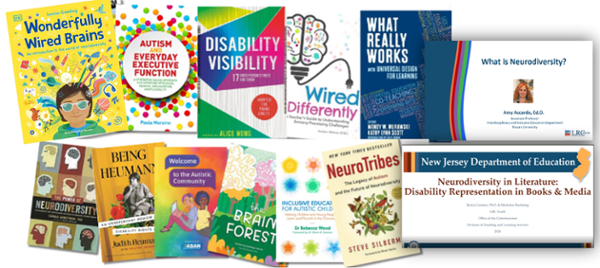
The LRC-S offers a collection of resources related to neurodiversity to support educators, students and families.
Disclaimer
These links are being provided as a convenience and for informational purposes only; they do not constitute an endorsement or an approval by the Learning Resource Center-South of any of the products, services or opinions of the corporation or organization or individual. The Learning Resource Center-South bears no responsibility for the accuracy, legality or content of the external site or for that of subsequent links. Contact the external site for answers to questions regarding its content.

