Discoveries in Education Spotlight: Margaret Thornton
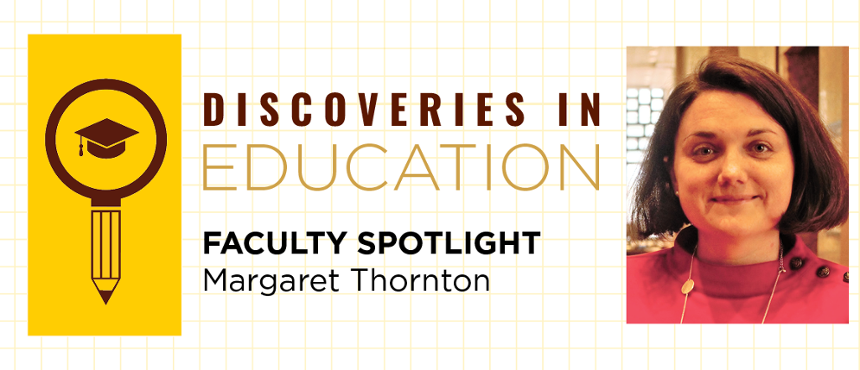
Discoveries in Education Spotlight: Margaret Thornton
Discoveries in Education Spotlight: Margaret Thornton
Rethinking Access Through Research and Practice
Dr. Margaret Thornton, Assistant Professor of Educational Leadership, Administration and Research at Rowan University, is helping reshape how schools think about access, opportunity, and academic rigor. Through her research partnership with Shaker Heights, Ohio, Thornton is studying how one district is working to expand access to its International Baccalaureate (IB) program and move toward becoming an “IB-for-All” district—breaking from long-standing traditions of academic tracking.
Her work sits at the intersection of research, practice, and policy, asking not just whether access can be expanded, but how schools can do so in ways that genuinely support students and educators alike.
Her work sits at the intersection of research, practice, and policy, asking not just whether access can be expanded, but how schools can do so in ways that genuinely support students and educators alike.
What Drives the Work
Thornton traces the roots of her work to scholars like Jeannie Oakes, whose research exposed how students from marginalized communities are often excluded from advanced coursework despite having comparable achievement levels to their more privileged peers.
“When I saw Shaker Heights actively working to dismantle that system,” Thornton explains, “I was excited to partner with them to discover where they’re succeeding and where they can continue to improve.”
Rather than approaching the project with a deficit lens, Thornton and her graduate research assistant, Arielle Sosland, have focused on learning from the district’s innovations while supporting reflection and growth.
“When I saw Shaker Heights actively working to dismantle that system,” Thornton explains, “I was excited to partner with them to discover where they’re succeeding and where they can continue to improve.”
Rather than approaching the project with a deficit lens, Thornton and her graduate research assistant, Arielle Sosland, have focused on learning from the district’s innovations while supporting reflection and growth.
Innovation in the Classroom
One of the most compelling examples Thornton observed was within Shaker’s 8th grade math classrooms. Teachers developed a choice-based system they call “mild, medium, spicy,” allowing students to select tasks aligned to the same learning standards but with varying levels of challenge.
All students complete the “medium” tasks, but they can begin with “mild” or extend into “spicy” activities based on readiness and interest. Crucially, teachers guide students’ choices intentionally so that no child becomes labeled or locked into one level.
“This approach keeps rigor high,” Thornton notes, “while also respecting student agency and avoiding the traps of traditional tracking.”
All students complete the “medium” tasks, but they can begin with “mild” or extend into “spicy” activities based on readiness and interest. Crucially, teachers guide students’ choices intentionally so that no child becomes labeled or locked into one level.
“This approach keeps rigor high,” Thornton notes, “while also respecting student agency and avoiding the traps of traditional tracking.”
Signs of Real Change
Beyond academic outcomes, Thornton noticed shifts in school culture as well. Many teachers reported fewer behavioral issues, a change they attribute to students being appropriately challenged and no longer grouped by perceived ability or behavior.
Even more telling, initial resistance to detracking has largely faded. Recent school board elections and a levy vote passed with overwhelming support for leaders aligned with the district’s inclusive vision—a powerful signal that the community is embracing change.
Even more telling, initial resistance to detracking has largely faded. Recent school board elections and a levy vote passed with overwhelming support for leaders aligned with the district’s inclusive vision—a powerful signal that the community is embracing change.
A Model for Broader Impact
Thornton believes Shaker Heights offers a powerful example for other districts wrestling with equity and access.
“No one likes to feel like opportunities are being taken away,” she says. “But that’s not what’s happening here. This is about expanding opportunity within a framework—the IB programme—that is built on integration and intellectual rigor for all students.”
Her work underscores that equity-driven reform does not require lowering standards, but reimagining who gets access to high standards—and how schools support them there.
For Thornton, Discoveries in Education means showing that research, when grounded in real classrooms and communities, can become a catalyst for lasting, systemic change.
“No one likes to feel like opportunities are being taken away,” she says. “But that’s not what’s happening here. This is about expanding opportunity within a framework—the IB programme—that is built on integration and intellectual rigor for all students.”
Her work underscores that equity-driven reform does not require lowering standards, but reimagining who gets access to high standards—and how schools support them there.
For Thornton, Discoveries in Education means showing that research, when grounded in real classrooms and communities, can become a catalyst for lasting, systemic change.


